John Beale Bordley established his Como Farm in West Bradford in 1791. Bordley was known as the “Father of American Agriculture” for his pioneering work to end the colonial practice of planting the same crop, year after year, until the soil’s nutrients were depleted and settlers were forced to move. Bordley arrived just as Chester County’s farms needed a rest from endless wheat planting.
In pamphlets he published for neighbors, Bordley encouraged the use of lime, plaster, manure and clover to replenish the soil. The idea transformed local agriculture and ushered in an era of prosperity from the late 1790s to the 1830s. Two of Bordley’s more popular books, Sketches on Rotations of Crops and other Rural Matters (1797) and Essays and Notes on Husbandry and Rural Affairs (1799), were based on the needs of West Bradford residents.
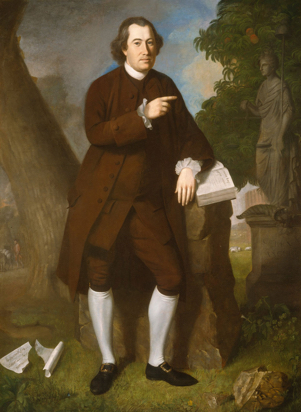
Portrait of John Beale Bordley by Charles Wilson Peale, 1770, courtesy of National Gallery of Art
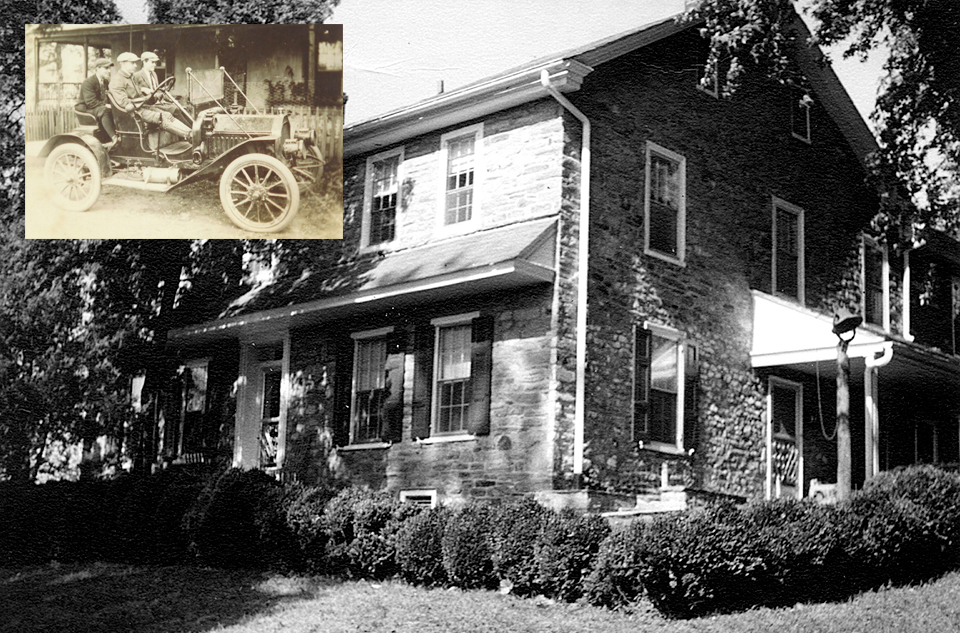
Bordley’s former home, now a golf clubhouse on Tattersal Way, West Bradford.
The Young family, pictured here along the Strasburg in 1920s, lived at Bordley’s Como Farm. Image courtesy of the Ramsey family and Jason Strouth
Bordley arrived just as Chester County’s farms needed a rest from endless wheat planting.
In addition to his experiments with crop rotation and soil enrichment, Bordley invented many labor- and time-saving devices. These included seeding and reaping equipment that Bordley invented to discourage slave ownership among his Maryland neighbors. Bordley also believed tenant farmers could be encouraged to stay on the farms with good housing. Bordley was a mentor for the Philadelphia Society for Promoting Agriculture (PSPA), whose membership included Ben Franklin and Thomas Paine.
Although Bordley was a contemporary of Humphry Marshall, there is no record of their friendship nor shared involvement in the scientific study of agriculture. A 1953 historic marker near Bordley’s former home, now part of a golf course and country club, describes the former Baltimore judge as a “noted agriculturist.”