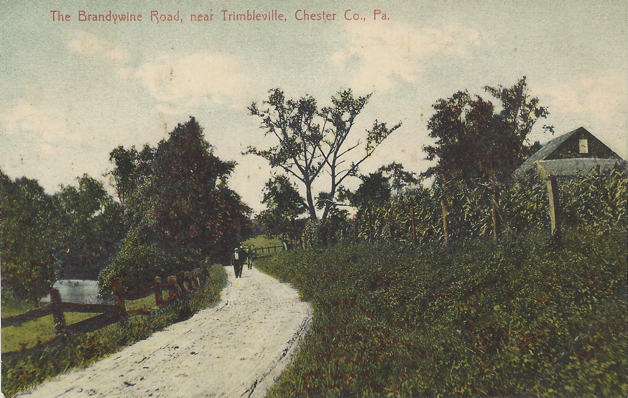
Postcard of the Brandywine Road near Trimbleville courtesy of the family of the late Bill & Florence Supplee.
Trimbleville, only a mile south of Marshallton, was first settled in the early 1750s by an Irish Quaker family. Brothers William and James Trimble, who married sisters, came to this lush region to buy a grist and saw mill complex with a third partner who was English. The brothers’ extensive land, situated against the sloping hillsides overlooking the Broad Run and the West Branch, formed the core of the hamlet.
James became the mill’s sole owner by 1777, when General Howe sent 9,000 British troops and all their supplies across Trimble’s Ford on the famous “Left Hook” towards the Battle of the Brandywine. James produced a number of heirs who inherited much of the Trimble land. In 1795, Robert Ingram, a third-generation blacksmith, arrived and established Trimbleville’s second successful business: a wheelwright and blacksmith shop, both of which are now private residences. Ingram may have had a family connection with the Irish homesteaders, since both his home and shops were eventually owned by generations of Trimbles.
Now an historic district, Trimbleville includes the mill complex with James’ original 1750s homestead, a barn and a re-built colonial-era mill. Along the nearby Northbrook Road, a grand 1820s Georgian-style home reveals the Trimbles’ proficiency in milling. Trimbleville was home to the Greenwood Dell, a prominent boarding school for boys, where Bayard Taylor, Chester County’s most famous early man of letters, was a student.
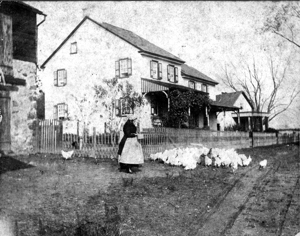
Trimblesville rural buildings reflected Quaker builders’ plain tastes of conservative lifestyles. Image courtesy of Chester County Historical Society.
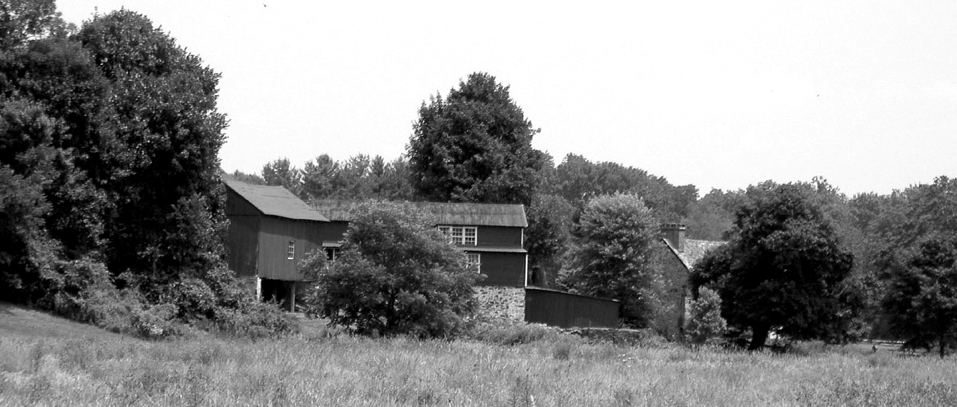
Trimbles Mill remained in operation for more than 200 years. Photo courtesy of the Chester County Historical Society.