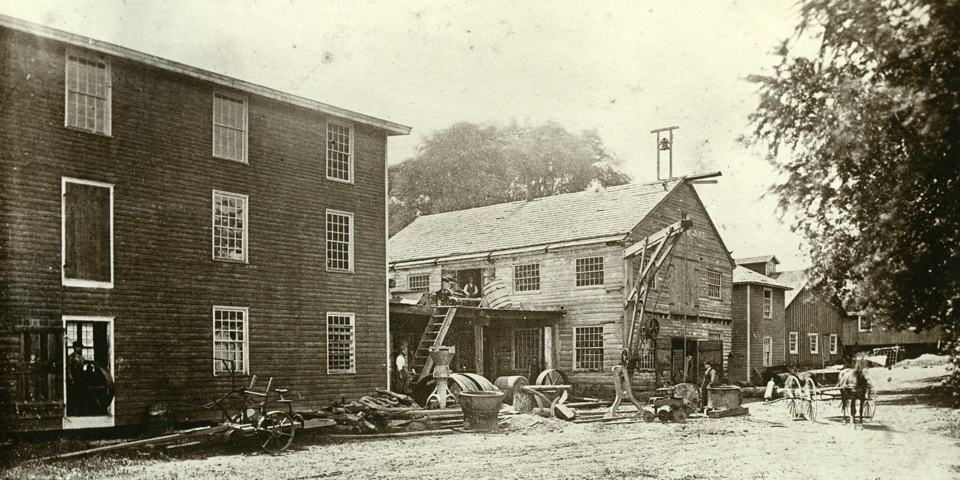
Edge Cope Mill, 1900. Image courtesy of the Chester County Historical Society.
Copesville was named for a Quaker family who first settled in the region in 1712. Not satisfied with only farming – like their neighbors the Taylors, who also owned a mill, hatter’s shop and inn along the Strasburg – the Cope family built a diverse entrepreneurial empire. As one historian put it, they “ground corn, cut timber and made forgings” and later ran one of Chester County’s most successful industries.
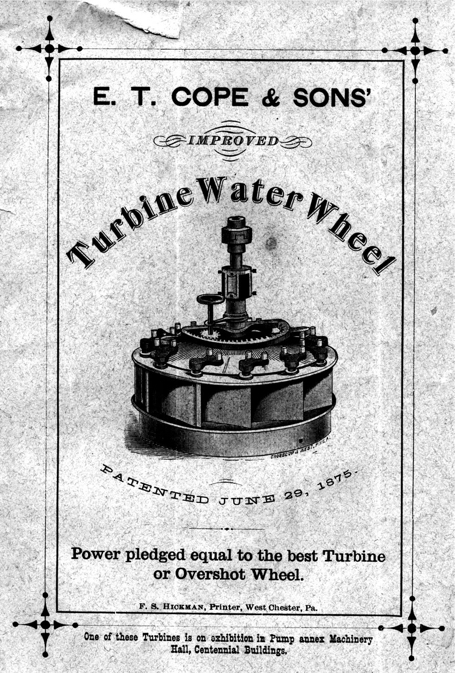
Ad for Cope’s Machine Works touts its display in the 1876 Centennial International Exhibition. Image courtesy of the Chester County Historical Society.
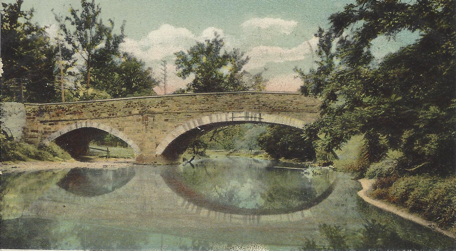
The stone Copes Bridge replaced a deteriorating wooden bridge. Postcard courtesy of the family of the late Bill & Florence Supplee.
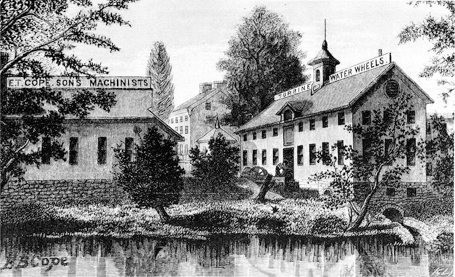
Edge Cope Machine Shop. Image courtesy of the Chester County Historical Society.
The Cope family built
a diverse entrepreneurial empire.
After Edge “E.T.” Cope established the Brandywine Machine Works on the opposite side of the Brandywine, the hamlet of Copesville appeared on maps for the next 50 years. Roof-top signs running the length of two buildings proudly proclaimed “E.T. Cope Sons Machinists“ and “Turbine Water Wheels.” Using waterpower from the river, the company manufactured complex and diverse products such as the iron Corinthian columns used to build the Chester County courthouse in 1845 as well as smaller, patented items like sausage cutters and cast-iron water troughs. Perhaps their most curious offering: E.T. Cope’s “Buckeye,” an improved version of the nation’s first circular-knife mower that curiously resembled today’s riding lawn mower.
By the early 1900s, Copesville was centered on a few scattered homes and a general store near Cope’s Bridge. The East Bradford hamlet never grew large enough to become part of Marshallton, only about three-quarters of a mile to the west.
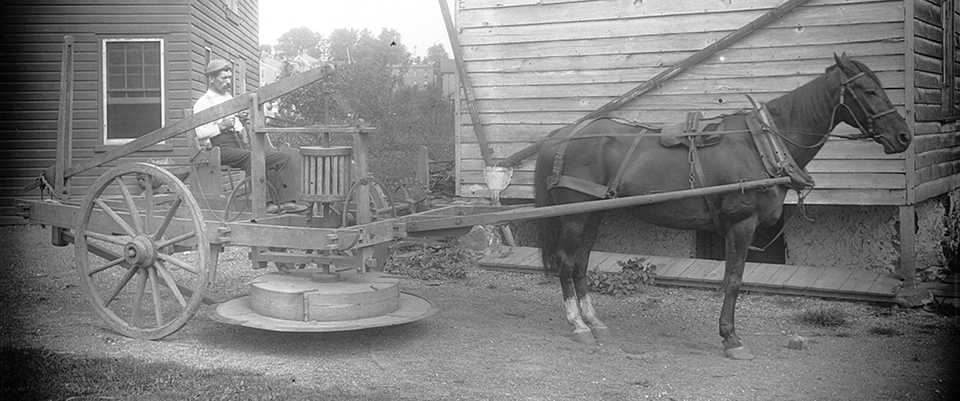
E.T. Cope’s “Buckeye,” an improved version of the nation’s first circular-knife mower that curiously resembled today’s riding lawn mower.