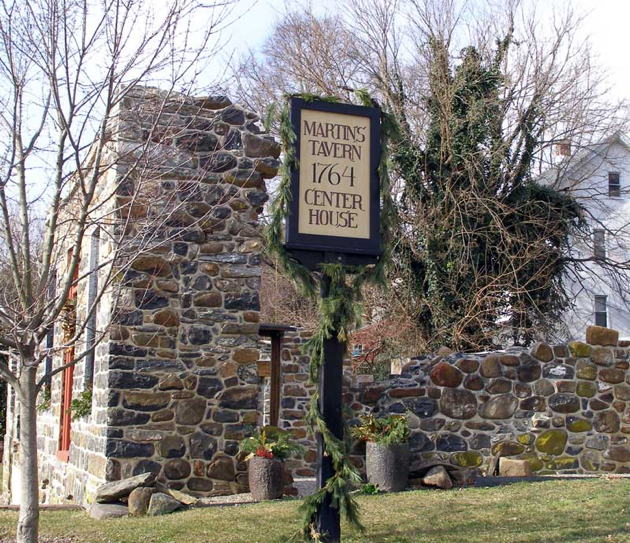

…members of the local militia preferred to convene at Martin’s Tavern in the months leading up to the Battle of the Brandywine.
As a village transformed by market routes,
Marshallton in 1777 was at the geographical center
of a much larger Chester County. Indeed, Martin’s
Tavern was the de facto government seat for those
Chester County residents who rejected the long trek to the county seat of Upland (now Chester, Pa.) The nearby settlement of Turk‘s Head, just west of Chester was Chester County’s largest settlement, but the Turk’s tavern owner was a Tory, loyal to the British Crown. Therefore, members of the local militia preferred to convene at Martin’s Tavern in the months leading up to the Battle of the Brandywine. Just a year earlier, the tavern had changed hands to Abraham Marshall, Humphry’s nephew and a retired captain in the Pennsylvania militia, and its reputation as a welcoming place for patriots remained firm.
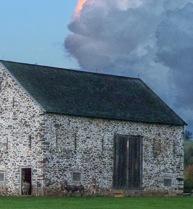
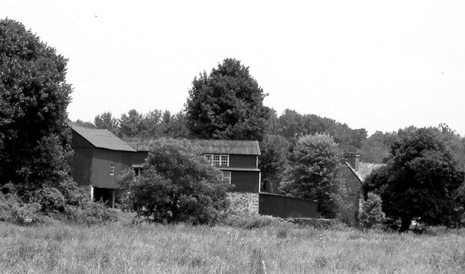
Abiah Taylor’s Barn photograph courtesy of Fred Weyman. (above) Trimble’s Mill photograph courtesy of Catherine Quillman. (right)
War came to the Brandywine Valley when it was the middle of harvest season and interrupted residents from preserving and storing food for the coming winter.
Taylor’s Mill, established near Cope’s Bridge in 1740, and
Marshall’s Mill, built sometime in the 1750s in Northbrook (near
Trimbleville), are among the region’s earliest mills. Both Mills were
located along the heavily travelled north-south routes through
Marshallton to Wilmington and Baltimore.
Many farmers sold their crops and grains to Philadelphia and feared that a British occupation would cut off supplies for the captured Americans and city residents. Residents faced losses that would take generations to recover. During the lean years of the American Revolution, West Bradford Farmers were grateful to have access to at least three mills to grind their wheat and grains.
Taylor’s Mill, Trimble’s Mill and Humphry Marshall’s Mill, were among Chester County’s earliest mills. The latter two were township’s longest running mills.
Locally, area wheelwrights and blacksmiths were asked to make horseshoes and chains to pull cannons and to make wheels for Conestoga wagons. Ironically, it was a local blacksmith and member of the Bradford Meeting named Curtis Lewis who unwittingly became a spy when he accepted a meeting with the British on September 10th and shared his knowledge of local roads and ford crossings.