General Howe had no intention of directing a full frontal assault at Washington’s Army. The British were not only better trained, they had more accurate maps and prior spy information. Employing “one of the more ingenious flanking maneuvers in military history”, as historian W. Barksdale Maynard calls it, Generals Howe and Cornwallis split the British Army and lead 9,000 troops north of Kennett Square and into West Bradford Township.
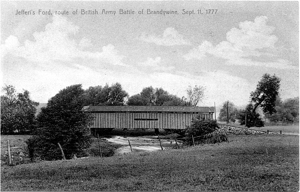
British soldiers crossed the Ford at Jefferis’ farm, ransacked his house, and took Mr. Jefferis as a guide. Postcard courtesy of the family of the late Bill & Florence Supplee.
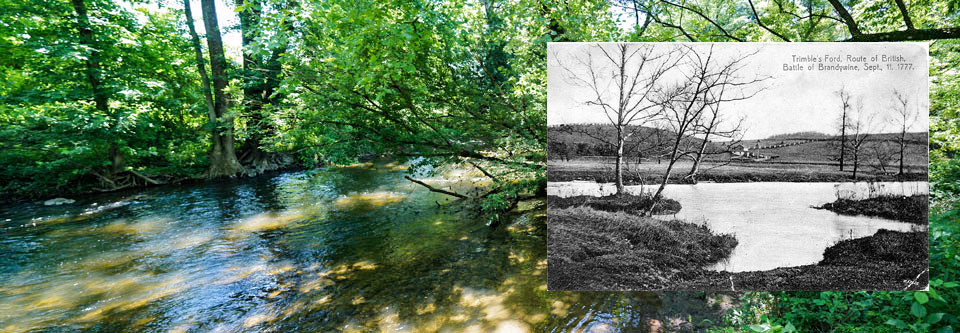
A proposed interpretive site and trail can take visitors close to the crossing used by British troops. Postcard courtesy of the family of the late Bill & Florence Supplee.
The British crossed above the Fork of the Brandywine at the unguarded Trimble’s and Jefferis’ fords. The wet crossings slowed the military columns, soldiers backing up on the floodplain, waiting for their turn to wade in water chest-deep, soaking their wool uniforms both times.
The wet crossings slowed the military columns, soldiers backing up on the floodplain, waiting for their turn to wade in water chest-deep…

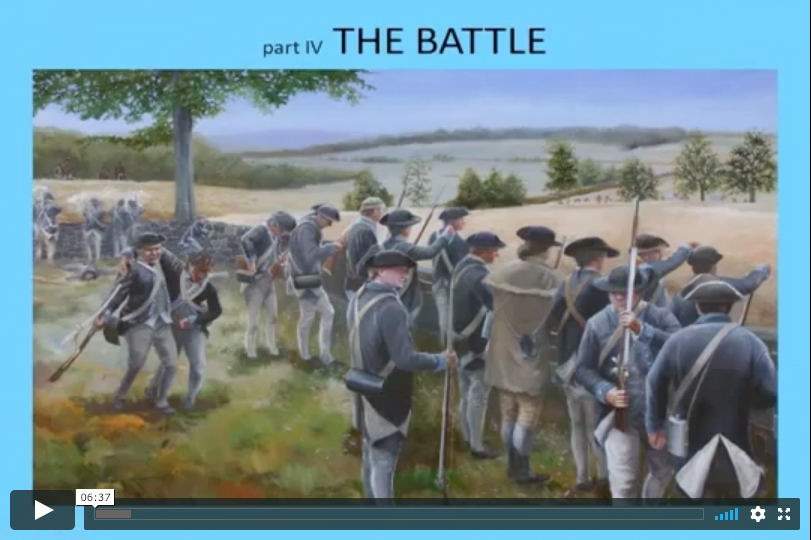
This video illustrates the collapse of the Continental line. Video provided by Chester County Planning Commission.
THE “LEFT HOOK”:
17
MILE MARCH
9
HOURS
2
FORDS
Delays were inevitable with columns involving every “horse and foot, artillery, baggage, provision wagons, arms and ammunition, together with a host of plunders and rabble,” as one onlooker described it.
The British sweeping 17-mile march took 9 hours to complete and nearly halted troops from heat exhaustion. But it enabled them to make a surprise flanking assault on the Americans’ exposed north in mid-afternoon. Three American divisions pivoted to meet the surprise British assault at Birmingham, but they were disorganized and overmatched. Upon hearing Howe’s men firing, Knyphausen, still just south at Chadds Ford, ordered his men forward on Washington’s center as well.
American lines crumpled as the fighting continued until sunset at a place now preserved as Sandy Hollow Heritage Park. The best Washington could hope for was delaying the British until darkness ended the battle for the day, enabling a hasty retreat towards Philadelphia.